Writing Prompts
Don't be a writer, be writing.
Writing prompts can be useful for any writer, at any stage. Like études for musicians, you can use them to train your creative muscles - or as the starting point for further composition. Writing prompts can help overcome the fear of the blank page, establish a writing routine, create new ideas when you're stuck, or simply let you have fun and enjoy writing! Writing prompts are also fantastic ice breakers in workshop settings and great tools for inductive teaching.
Below is a list of writing prompts I have collected, used myself, and tested with students and workshop participants over the years.
My top three creative writing prompts
1. Free writing / Automatic writing
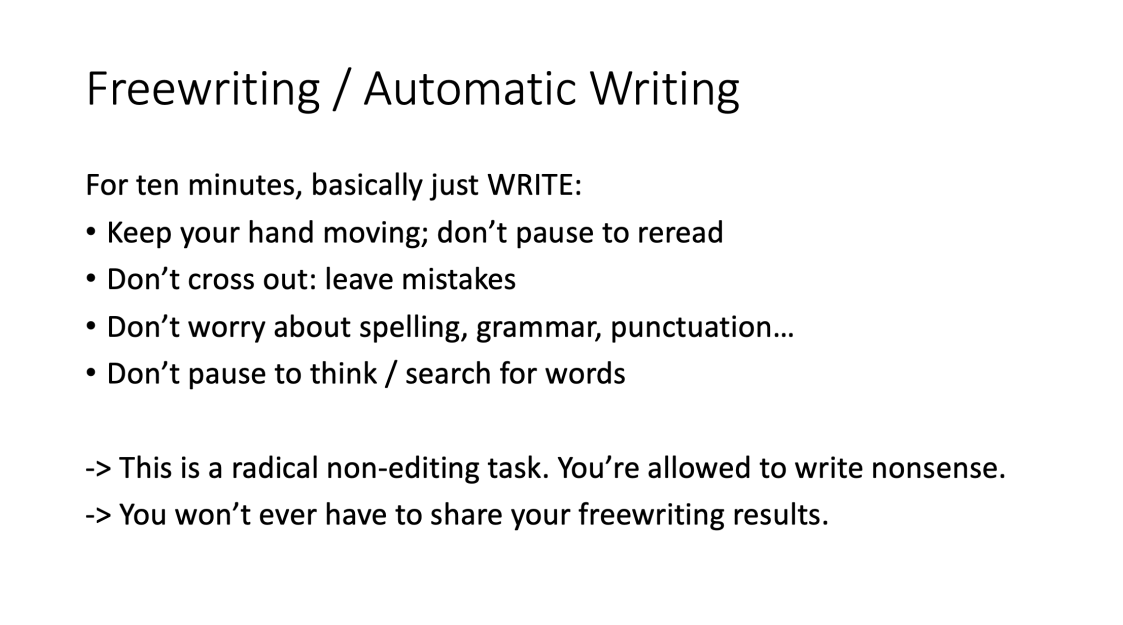
As the name suggests, free writing or automatic writing is an invitation to write freely, without thinking, without concern for grammar, style, content, or structure. Many writers regularly use this method. I love it, because it forces you to really just focus on the raw practice of writing - and never fails to surprise. Simply set a timer for 5, 10, 15, 20, 30 minutes, start writing, and, more importantly, don't stop. Free writing is radical non-editing. It's a wonderful warm-up task and a great prompt to overcome the fear of the blank page and get the creative juices flowing. It's also a good mental health tool to empty your brain and handle spiralling thoughts. I like to go for a walk, sit down somewhere and do 5 minutes of free writing in my new environment.
I strongly recommend doing this task manually, because it means you can follow the movements of your hand on the page and you will activate the physical connection between writing and your body. This task is supposed to remove fears and barriers and encourage people to write - well, freely. When using this task in a workshop setting, I thus always remind participants that they will never have to share what they have written.
I often use free writing as a warm-up task only. However, there are various other things you can do with your free writing, depending on your mood and intention:
- When you're trying to get rid of spiralling thoughts: actively screw up your piece of paper, tear it apart, and throw it in the bin!
- When trying to understand your current mood and / or thoughts and / or ideas: Read what you have written. Read it again. Take a few minutes to reflect on it, then try to articulate 1-3 clean statements that emerge from the text.
- When you want to use the task as a starting point for further writing:
3 Free-writing variations:
- Read what you have written. Circle 3-5 words that speak to you in some way. Could one of them be the starting point for a story? Could you write a story that contains all the words you have circled?
- Read what you have written. Circle one phrase that stands out to you. Use it as the title / first sentence / last sentence of a poem or short story.
- Read what you have written. Imagine it is a letter you found in your postbox. There is a return address, but no name. Write a response to the anonymous sender.
2. List poem
I love lists, so maybe it's no surprise that I absolutely love list poems. The difference between a list poem and a list is subtext and intention: list poems deliberately arrange things to create relations; to sustain interrupt, and transform repetitive elements. The list or catalogue poem is one of the oldest poetic forms and extremely versatile. Many poems (and also prose texts) contain a list element of some kind, sometimes more, sometimes less visible. John Ashberry's “Into the Dusk-Charged Air” is crafted around a list of rivers of the world. Raymond Carver's “Fear” is a straightforward list of things the poetic I fears. Joe Brainard wrote an entire experimental memoir about his childhood in the form of a list, each sentence starting with “I remember”. Etel Adnan's lyrical vignette “To be in a Time of War” from In the Heart of the Heart of Another Country (2005) is a sequence of lists: “To say nothing, do nothing, mark time, to bend, to straighten up, to blame oneself, to stand, to go toward the window, to change one’s mind in the process, to return to one’s chair […]”
List poems are easy to do and hard to do well. Above all else, they force you to think about structure. Listing things, feelings, sensations, or observations can be a great starting point and a good method to organise your ideas and write something when you think you can write nothing. To make list poems effective, I use these two rules of thumb:
- Whatever you list must be interesting
- It must be as specific as possible → when listing things you like, for example, don't just write “the sun”, but try to think about what exactly it is you like about the sun, the sensation, the experience.
Titles are also very important, as they provide context and reading guidance.
Again, you can use the list poem as a simple warm-up task or review what you have written and take it further. The possibilities are very much endless. List poems are a good way to dive into editing and rewriting. You can start by reviewing your list and cross out the things you find least interesting.
Here are some of my favourite list poem prompts:
- Take a look around you. Write down 3-5 things you can hear, smell, taste, touch, and see. Start every sentence with “I can hear/smell/taste/touch/see”. This is a great prompt to try outside or in a new environment.
- Write down five things you do every day.
- Write down five things you wish you had in your bag.
- Write down five things you can feel in your body right now.
- Make a list of what you look forward to.
- Make a list of what you feel thankful for.
- Write down five things that are possible.
List of all the days of the week. Under each day, write three words / things of what you did or about what happened on that day last week.
3. Procedure
Procedural / process-oriented or conceptual poetry sometimes gets a bad rep, but I agree with Nathan Austin, who writes that "the best works allow us to rethink ourselves, and our position(s) within the world and society, as well as our conventional understandings of authorship and creativity."
Procedural work takes a set of rules, a concept, a “recipe” as the starting point for writing. Language is treated more like matter, and the expression lies not in the content but in the execution of the idea. The concept or procedure for your writing prompt can be anything you want, from formal constraints (line length, for instance) to more holistic procedures (writing at a specific time, on specific material, etc.). The possibilities are endless – procedural poetry is not about producing “beautiful” or perfectly polished texts but about constraint and experiment. Check out Juliana Spahr’s poem “Things of Each Possible Relation”, which is based on a specific translation procedure, or Christian Bök’s “Eunoia”, which famously consists of texts that only use one vowel. If you want to dive deeper into conceptual work, you might want to read more about OuLiPo, the collective of writers and mathematicians founded in 1960 that created literature using mathematical and linguistic constraints.
Here are some simple ideas for procedural writing:
- For a week, write down the first word that comes to mind when you get up. Use these words to write a poem
- Pick a random book, flip it open on a random page, and pick the first sentence that stands out to you. (You can also decide to always use the first, last, seventh, etc. sentence). Compose a poem entirely consisting of words / sentences sourced this way.
- Write a poem that records all the noises you hear in one day
- Write a poem on a piece of wood
- Write a poem using only words you saw / heard today
More writing prompts
Poetry Prompts:
- Pick five random words. Use them to write five acrostic poems, i.e. use each letter in each word to form a word.
- Write a poem that doesn't include “I”.
- Write a line-palindrome or a palindrome poem (a poem that reads the same backwards and forwards).
- Write a poem that is also a letter (known as an epistolary poem).
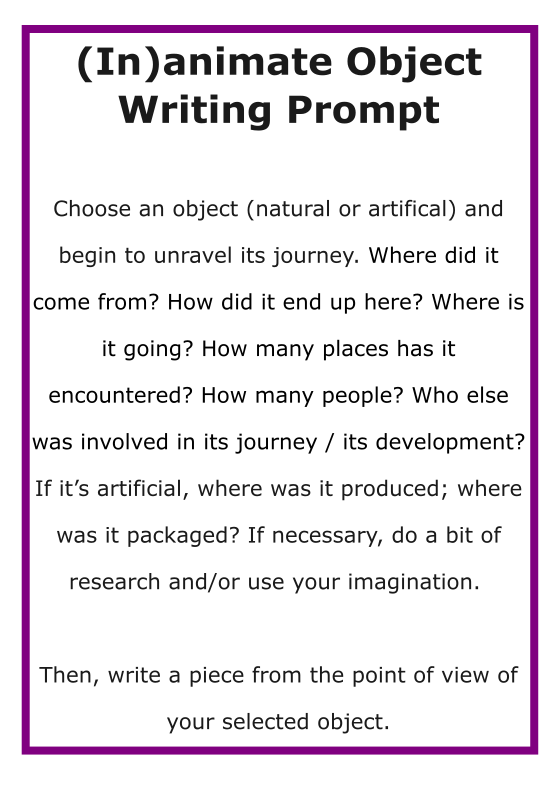
- Go for a walk. During the walk, write a poem from the perspective of something that is not human, for instance, a blade of grass.
- Write a poem that is based on a dream.
- Write a visual poem that uses the page in an usual way.
- Write a poem that starts in the bottom right corner of the page.
- Write a poem in iambic pentameter.
- Pick a classical poem. Translate it into contemporary language. Then, write a new poem based on the translation.
- Write a poem that begins and ends with the same line. You could use a line from a poem / book.
- Write a poem that begins with “Once upon a time…”
- Write a Haiku. See this excellent article on Haikus and why they don't have to follow the 5-7-5 structure.
- Write a poem in which the speaker only gradually approaches a given phenomenon. First it is seen, then heard, then smelled, then tasted, then touched.
Prose & Other Prompts
- Rewrite a fairy tale from the perspective of a minor character.
- You are renovating a home. Imagine that you are the home. What is your foundation? What are you working on fixing? What needs to be replaced and what makes your house a home?
- Go for a long walk. Make up a word that describes a specific phenomenon or feeling you encountered during that walk.
- Open the nearest book to you and flip through the pages. Pick five random words. Write a 1-2 page short story containing these words. One of the words must be the last or first one.
- Write a short autobiographical piece that starts with "The one thing I wish people knew about me is..."
- Write a 1-page story that starts with: “I didn't think the house was actually haunted until…”
- Fill in the blanks. Use as many words as you want but don't write more than 4 sentences:
He used to be a _. But when _ , he _.
There was _ .Then _ laughed. - Go outside and find a name. Start creating a character with that name.
- Write a one-page short story that begins with the line "I didn't see that one coming."
- Write a short story based on a memorable Christmas tradition from your childhood.
- Spend a five minutes imagining a garden in which you find something unexpected. Then do five minutes of free writing.
3. Group writing prompts
- Collective poem – easily my favourite group writing prompt of all times. It never fails, often results in laughter, and always breaks the ice. Write a line on a piece of paper, hand it to the next person, asking them to read the line and write something in response. Fold the paper, so that the next person will only see the previous line. Repeat and pass round until the paper is full. Invite a group member to read it out aloud.
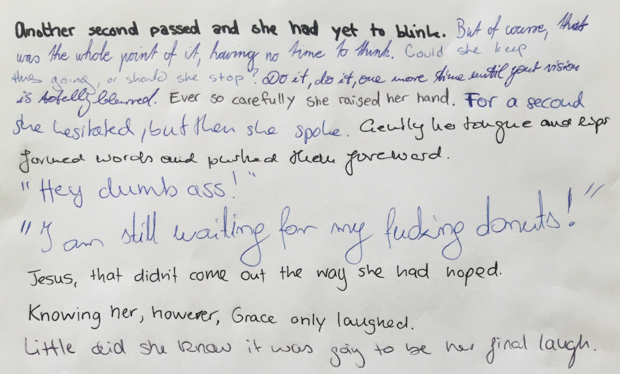
- ABC story – you can also do the abc story on your own, or do it as a poem instead. It's a great prompt to practice finishing. In a group, it often yields very funny results. Passing round a piece of paper, the first person writes a sentence starting with an A, the second one starting with a B, and so on, until you reach the letter Z. (In the example story, we only made it to letter L.)
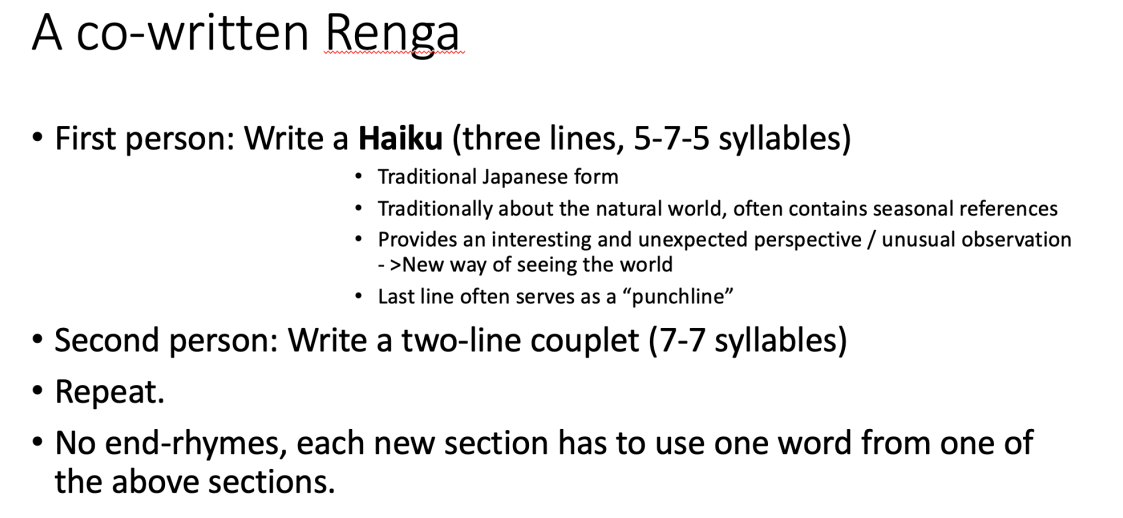
- Collective Renga – this one's a bit trickier and requires a little more time. See the instructions below (and see my earlier note on Haikus.)