About me
Keep reading for an honest narrative CV that includes failures and commentary. For a polished CV, scroll down.
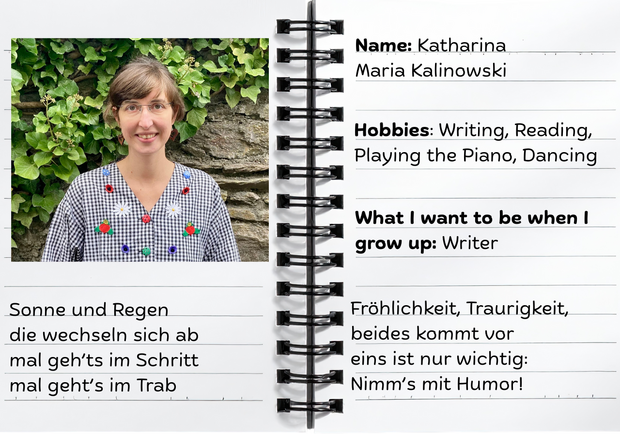
I have always been fascinated with language. Growing up in rule-obsessed Germany, I fell in love with writing, particularly poetry, because it gave me a space to flout the rules and reinvent language. In German we call it dichterische Freiheit (poetic freedom), which sounds more liberating than poetic licence. I knew I wanted to pursue and claim that freedom. When I was in primary school, exchanging friendship or memory books was a popular activity. Funnily enough, these books are called Poesiealbum (poetry album) in German, because traditionally people would write little poems or aphorisms in them. The modern versions have prompts and questions inviting you to write about yourself – what your favourite colour is, what you like to do in your free time and so on. In response to the question “What do you want to be when you grow up?,” I always wrote “author”, by which I really meant writer, a word that doesn't have an established noun counterpart in German and that emphasises the writing activity over the act of authoring. Writing, engaging with its varied forms, making space for writing, teaching writing, writing about writing, is still what I'm doing today.
However, studying writing at university level – which was what I wanted to do after finishing school– wasn't really an option. In contrast to the US, Australia, the UK, or Ireland, Creative Writing was and still is not an established subject in higher education in Germany. With the determination and lightheartedness of a 18-year-old, I decided to move to England and study Creative Writing at De Montfort University in Leicester. Back then, tuition fees were much lower and support options by the German government much better. I had a fabulous team of lecturers who introduced me to all sorts of weird and wonderful writing. I fell in love with the English language and really started to focus on poetry, particularly modernist, visual, and experimental poetics. Writing in a second language gave me even more courage to make use of my poetic freedom.
I was not ready to return to Germany after my undergraduate degree and decided to pursue an MA in Writing at the University of Warwick. It was then that I discovered ecopoetics, a term encompassing so many paradoxes, complications, and frictions that I knew I wanted to spend more time with it. After my master's degree, I developed a proposal for a PhD project bringing together ecopoetics, translation, and creative writing to investigate contemporary ecologically-inclined poetry as a form of translation of and with the natural world.
At the University of Cologne, where I was eventually lucky enough to receive a scholarship for what would become an intellectual, creative, emotional, and physical journey involving three countries, my project was very unusual in its inclusion of creative writing and interdisciplinary to the point nobody knew which discipline I belonged in. Ironically, this is what ecopoetics is all about – crossing boundaries, complicating disciplinary categories. This has become, or maybe subconsciously always been, an essential part not only of my research but also my general philosophy of life. Life doesn't always follow the rules and cannot be squeezed in categories. Life is wild, complicated, and unknown. Writing is about the unknown, as is research. Research needs to be able to challenge existing boundaries and pursue lines of thought, language, and genuine inquiry rather than those of money, power, and influence. It rests on the ability to think and write freely.
During my PhD, I lived in Dublin, Canterbury, and Cologne. After successfully concluding it, I taught and tried to promote Creative Writing as a subject at the University of Düsseldorf, aiming to give students the option that I didn't have. I loved teaching and seeing the amazing ideas students came up when given the space. However, I felt increasingly frustrated with the state of academia – the prioritisation of credit points at the expense of knowledge, the growing precarity of jobs, the suppression of debate, the reliance on third-party funding… the list goes on and on. At the same time, and despite protest from the student body, efforts to establish Creative Writing failed due to rigid structures and a lack of management support.
Moving yet again, I started a job as a Literary Editor in Derry in Northern Ireland, a job which I really enjoyed and which gave me the opportunity to share writing with the broader community. I soon found out, though, that the toxic work atmosphere and the organisation's uncritical use of Artificial Intelligence were incompatible with my views and the work we were supposed to be doing. As you may know, AI, as James Muldoon, Mark Graham, and Callum Cant write so aptly in Feeding the Machine: The Hidden Human Labor Powering A.I. (2024), is essentially an “extraction machine” that is fuelled by the extraction of “capital, power, natural resources, human labour, data, and collective intelligence, which are transformed into statistical predictions, which AI companies, in turn, transform into profits.” (p. 9) I have no desire in taking part in this extraction, especially not under the pretense of improving people's lives.
With AI only being one of many technological developments, the world has changed a lot since I was a little girl writing in my friends' memory books. While the global present is as chaotic, complex, and unpredictable as ever, I try to hold on to my poetic freedom. I translate, write, do research, give workshops, and strive to share the possibilities and potentials of writing.
Poetry remains resolutely useless in an economic sense (if not entirely uncontaminated by the logic of capitalism). It is the 'purer' product of the Program Era.
Lauren Glass
CV
Education
PhD in English Literature & Poetry: Text, Practice as Research (summa cum laude)
University of Cologne & University of Kent
Additional Dr. Europaeus certificate in collaboration with University College Dublin
2017-2021
MA in Writing (With Distinction)
University of Warwick
2014-2015
BA (Hons) in Creative Writing and Drama Studies (First Class)
De Montfort University
2011-2014
Employment
Literary Editor
Verbal, Derry-Londonderry
2024-2025
Adjunct Lecturer
Heinrich-Heine-Universität Düsseldorf
Modern English Literature | Artistic Research
2022-2024
EU-researcher | Marie Skłodowska-Curie Fellow
a.r.t.e.s. Graduate School for the Humanities Cologne
2017-2020
German Translator
Language Insight Ltd., London
2015-2017
Professional Memberships
- New York School Studies Network
- National Association for Writers in Education (NAWE)
- European Association for Creative Writing Programmes (EACWP)
- Member of the Research Group Extraterrestrial Posthumanism
- Co-Founder and convenor of the Creative Writers’ Forum within the European Association for the Study of Literature, Culture, and Environment (EASLCE)